
This comprehensive guide serves as an authoritative technical handbook for ChaseBet, a prominent online casino brand tailored for the Australian market. We will deconstruct its operational framework, from the underlying software architecture of the ChaseBet app to the precise mathematics governing its bonuses and the robust security protocols protecting user data. This is not a superficial review but a systematic analysis designed for users seeking to optimize their experience and understand the platform’s technical and financial mechanics.
Before You Start: Pre-Registration Checklist
Ensuring a smooth onboarding process requires preparation. Verify the following before initiating your ChaseBet login and registration:
- Jurisdictional Compliance: Confirm you are physically located within a licensed territory (e.g., Australia) and are of legal gambling age (18+).
- Documentation Readiness: Have a valid government-issued ID (Passport, Driver’s License) and a recent utility bill or bank statement (not older than 3 months) for KYC verification.
- Payment Method Pre-Verification: Ensure your chosen deposit method (e.g., credit card, e-wallet) is activated for online transactions and you are aware of any potential fees from your financial provider.
- Network Security: Connect via a secure, private Wi-Fi network. Avoid public hotspots when creating an account or making financial transactions.
- Device Compatibility Check: Verify your device’s OS meets the minimum requirements for the ChaseBet app (iOS 11.0+ or Android 7.0+).
Architectural Overview & Account Creation
The ChaseBet platform is built on a multi-tier architecture separating the client-facing interface, application logic, and game server databases. Account creation establishes your unique node within this system.
- Initiation: Navigate to the ChaseBet homepage and select ‘Sign Up’ or ‘Register’.
- Data Layer Input: Populate the registration schema with accurate personal details (name, DOB, email, phone). Inconsistency here will cause critical KYC failure later.
- Credential Generation: Create a strong, unique password (12+ characters, mixed case, symbols) and a username. This forms your primary ChaseBet login keypair.
- Contractual Agreement: Digitally sign the Terms & Conditions and Privacy Policy. It is critical to understand the bonus wagering requirements and withdrawal policies stipulated here.
- Account Activation: Verify your email address and/or mobile number via the sent OTP (One-Time Password). This completes the initial registration protocol.
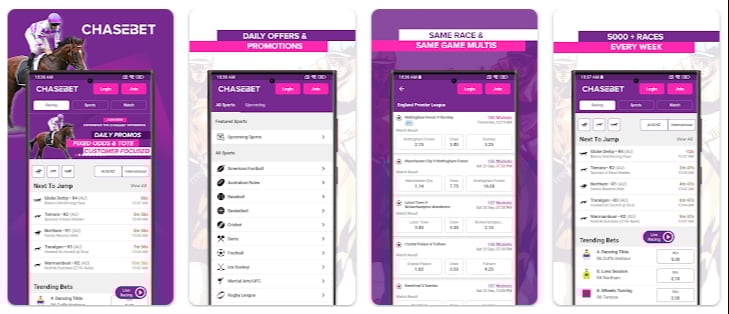
Mobile Client: The ChaseBet App Deep Dive
The ChaseBet app is a natively compiled client for iOS and Android, offering performance advantages over web-based wrappers. Its architecture includes local caching for faster game loading and push notification services.
| Component | Specification |
|---|---|
| Delivery Method | Native APK (Android) / App Store (iOS) & Progressive Web App (PWA) |
| Core Technology Stack | iOS (Swift), Android (Kotlin/Java), HTML5 for game integration |
| Minimum OS Version | Android 7.0 (Nougat), iOS 11.0 |
| Critical Permissions | Network Access (Essential), Storage (Optional, for caching) |
| Average Binary Size | ~45 MB (Android APK), ~80 MB (iOS via App Store) |
| Update Frequency | Bi-monthly for feature updates; game updates are server-side. |
Installation Protocol: For Android, download the APK directly from the ChaseBet website, enabling ‘Install from Unknown Sources’ temporarily. For iOS, download directly from the App Store. The PWA can be added to your home screen via the browser’s ‘Add to Home Screen’ function.
Bonus Mathematics & Wagering Simulation
Understanding the algorithmic conversion of bonus credits to withdrawable cash is paramount. Let’s model a common scenario.
Scenario: You deposit $100 and claim a 100% match bonus ($100 bonus). The bonus has a 30x wagering requirement (WR) on the bonus amount. Game contribution is 100% for slots, 10% for blackjack.
Key Formula: Withdrawal Threshold = (Bonus Amount * WR) / Game Contribution Rate.
Calculation Path A (Slots only):
Total Rollover = $100 (Bonus) * 30 = $3,000.
You play slots (100% contribution). Every $1 bet counts as $1.
You must wager $3,000 on slots before the bonus is converted and withdrawable.
Assuming a 96% RTP, expected loss during wagering = $3,000 * (1 - 0.96) = $120.
Calculation Path B (Blackjack only):
Total Rollover = $3,000 remains.
Blackjack contributes 10%. Every $1 bet counts as $0.10.
Effective wagering required = $3,000 / 0.10 = $30,000.
Expected loss (98% RTP) = $30,000 * (1 - 0.98) = $600.
This simulation clearly demonstrates the severe financial impact of low-contribution games on bonus conversion costs.
Financial Network: Deposits & Withdrawals
ChaseBet integrates multiple payment gateways. Transaction success depends on endpoint authorization and fraud scoring algorithms.
| Method | Transaction Type | Processing Time | Encryption Standard | Fee Liability |
|---|---|---|---|---|
| Credit/Debit Card (Visa/MC) | Deposit & Withdrawal | Instant / 1-3 Banking Days | PCI-DSS TLS 1.3 | User (May Apply) |
| Cryptocurrency (BTC, ETH) | Deposit & Withdrawal | Network Confirms (10-60 mins) | On-chain & SSL | Network Fee |
| Bank Transfer | Withdrawal | 2-5 Business Days | SWIFT/SEPA | Varies by Bank |
| E-Wallets (Skrill, Neteller) | Deposit & Withdrawal | Instant / <24hrs | Proprietary AES-256 | Provider Fee |
Withdrawal Protocol: All withdrawal requests trigger an automated security and bonus compliance check. If you have an active bonus, the system will verify the wagering requirement status before authorizing the transaction. The first withdrawal typically mandates full KYC verification.
Security & Data Integrity Protocols
ChaseBet employs a defense-in-depth strategy:
- Encryption: All data in transit uses TLS 1.3 with 256-bit encryption. Sensitive data at rest is hashed using SHA-256.
- Authentication: The ChaseBet login process should be secured with 2FA (if offered). Session tokens have a timeout period.
- Game Integrity: Game outcomes are determined by certified Random Number Generators (RNGs) audited by independent third parties (e.g., iTech Labs, GLI).
- Network Security: DDoS mitigation and Web Application Firewalls (WAF) protect against external attacks.
System Troubleshooting & Debugging
Common point-of-failure analysis and resolution steps.
Issue 1: ChaseBet Login Failures (Error 401/403)
- Cause: Invalid credentials, account lockout due to multiple failed attempts, or stale session cookie.
- Solution: Use ‘Forgot Password’ to reset. Clear browser cache/cookies. If using the ChaseBet app, force close and restart. Ensure CAPS LOCK is off.
Issue 2: ChaseBet App Crashing on Launch (Android)
- Cause: Corrupted local cache, incompatible device profile, or missing OS update.
- Solution: Go to Device Settings > Apps > ChaseBet > Storage > Clear Cache & Data. Reinstall the latest APK from the official site. Ensure your OS is updated.
Issue 3: Deposit Processed but Balance Not Updated
- Cause: Payment gateway delay, transaction pending bank authorization, or minor UI sync error.
- Solution: Wait 5-10 minutes. Log out and perform a fresh ChaseBet login. Check your payment method’s transaction history for a confirmed status. Contact support with the transaction ID.
Issue 4: Game Freezes or Fails to Load
- Cause: Unstable internet connection, insufficient device RAM, or outdated Adobe Flash/WebGL support.
- Solution: Switch from Wi-Fi to mobile data or vice versa. Close other running applications. For browser play, update to the latest version of Chrome/Firefox and enable WebGL.
Extended Technical FAQ
Q1: What license governs ChaseBet’s operations, and what is its regulatory authority?
A: ChaseBet operates under a license issued by the Curacao Gaming Authority. The license number should be displayed in the website footer. This mandates compliance with international standards for fair play and anti-money laundering (AML).
Q2: How are Return to Player (RTP) percentages calculated and verified?
A: RTP is calculated over millions of game rounds by the game provider’s RNG. Independent auditing firms like iTech Labs test and certify these RTP values (e.g., 96.2% for a specific slot). The theoretical RTP is a long-term average, not a short-term guarantee.
Q3: What is the exact data flow during the KYC verification process?
A: 1) You upload document scans. 2) Files are encrypted and sent to a secure verification server. 3) OCR and human checks validate authenticity. 4) Data points are cross-referenced with external databases (soft check). 5) A ‘verified’ flag is set on your account database record.
Q4: Can I run the ChaseBet app on an emulator like BlueStacks?
A: Technically possible, but strictly prohibited by Terms of Service. Emulator use triggers automated fraud detection systems, leading to immediate account suspension and confiscation of funds.
Q5: What happens to my account data if I self-exclude or close my account?
A: Per data retention policies, your account is deactivated but core personal and transaction data is archived for a legally mandated period (typically 5-7 years) for regulatory, tax, and responsible gambling oversight.
Q6: How does the ‘Instant Play’ browser version differ technically from the native app?
A: Instant Play is a responsive HTML5 website. It has higher latency and relies on browser performance but requires no installation. The native app has direct hardware access for smoother graphics, push notifications, and can cache resources locally.
Q7: What specific Responsible Gambling tools are available at a protocol level?
A: Tools include deposit limits (enforced at the payment gateway API), session time limits (enforced by server-side timers), self-exclusion (which globally flags your account across the system), and reality check pop-ups (triggered by client-side scripts).
Q8: If I suspect a game result is incorrect, what is the dispute resolution protocol?
A: 1) Immediately take a screenshot/video. 2) Contact support with the game ID, timestamp, and your account. 3) Support will request a game log from the provider’s server. 4) The log, containing the seed and outcome hash, is reviewed for integrity. This process is auditable.
Q9: How are random number seeds generated for the games?
A: Seeds are typically generated using a combination of hardware entropy sources (server clock nanosecond data, network packet arrival times) and cryptographic algorithms. For provably fair games, the seed is revealed after the round concludes.
Q10: What is the backup and disaster recovery plan for player funds and data?
A: Licensed operators must hold player funds in segregated accounts. Data is backed up in real-time to geographically redundant data centers. Recovery Time Objective (RTO) and Recovery Point Objective (RPO) are part of their mandated business continuity plan.
Conclusion
Mastering ChaseBet requires moving beyond basic gameplay to an understanding of its technical infrastructure and financial rules. From the efficient architecture of the ChaseBet app to the critical path of bonus conversion mathematics and the robust security enveloping every transaction, each component is designed for a specific operational purpose. By applying the diagnostic procedures for ChaseBet login issues, comprehending the wagering algorithms, and utilizing the platform within its designed technical and regulatory parameters, users can achieve a optimized, secure, and informed iGaming experience. Always prioritize responsible gambling and treat the platform as a technical system governed by strict logic and rules.